
Foundation Repair vs. Foundation Replacement: Which Do You Really Need?
Last updated April 2026
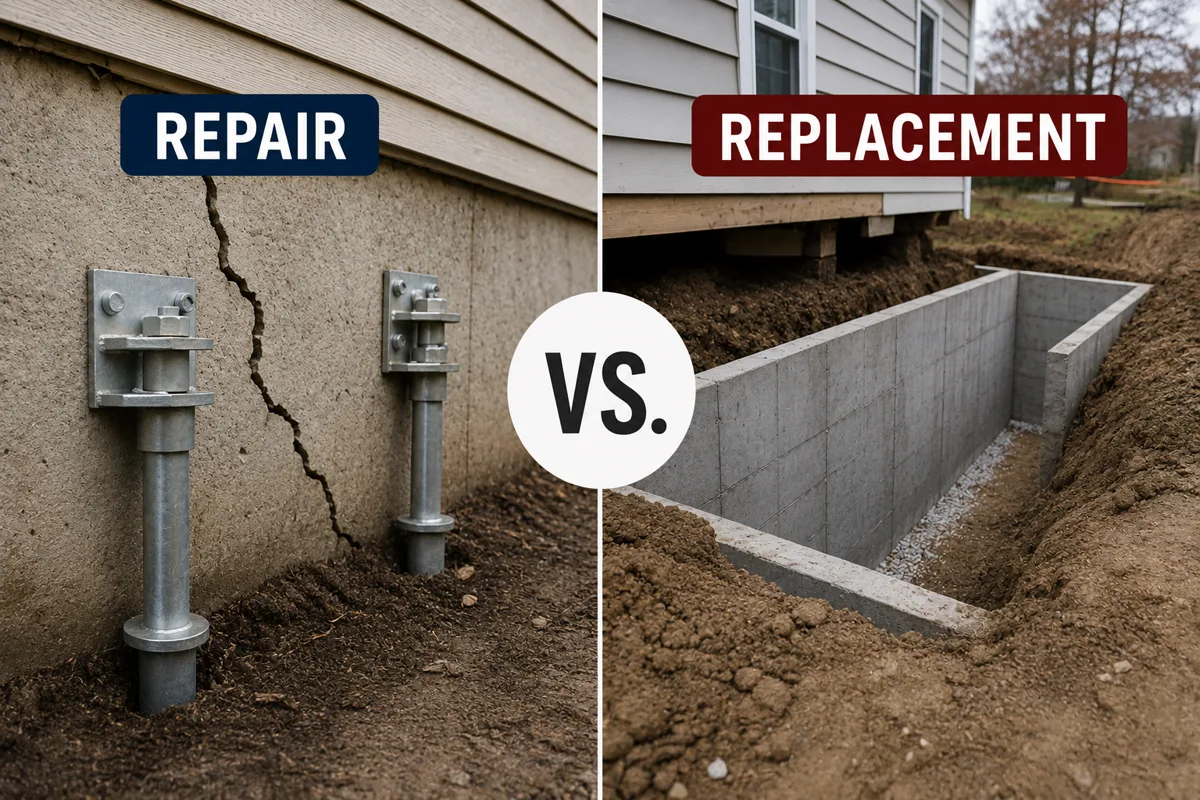
Foundation repair is usually appropriate when damage is localized and the existing foundation can be stabilized. Complete foundation replacement is generally considered when deterioration or structural failure is so extensive that repairing the existing foundation is no longer practical. The right solution depends on the cause, severity, foundation type, soil conditions, and overall structural condition of the home.
A Foundation Crack Does Not Automatically Mean You Need a New Foundation
Few phrases worry homeowners more than:
"You have foundation damage."
It is easy to imagine the worst.
Excavators around the house. Walls being removed. Huge repair bills. Maybe even the entire foundation being replaced.
Fortunately, foundation problems are rarely that simple.
A home can have noticeable cracking, settlement, or wall movement and still be a candidate for targeted foundation repair rather than complete replacement.
On the other hand, there are situations where deterioration becomes extensive enough that repairing individual sections no longer makes financial or structural sense.
So how do you know which situation applies to your home?
It starts with understanding the difference between repairing a foundation and replacing one.
Foundation Repair and Replacement Solve Different Problems
The terms sound similar, but the scale is very different.
Foundation Repair
Foundation repair attempts to stabilize, reinforce, or correct specific problems while preserving most of the existing foundation.
Depending on the condition, this may involve:
- Foundation piers
- Wall stabilization
- Crack repair
- Bowed wall correction
- Structural reinforcement
- Drainage improvements
- Waterproofing
The objective is to address the cause of the problem while retaining the foundation wherever practical.
Foundation Replacement
Foundation replacement is much more extensive.
It may require sections of the existing foundation to be removed and reconstructed, or in severe cases, substantial portions of the foundation may need replacement.
This type of project can involve:
- Supporting or lifting portions of the home
- Excavation
- Demolition
- Removing failed foundation materials
- Constructing new footings or walls
- Waterproofing
- Drainage work
- Restoring disturbed landscaping and finishes
Replacement is therefore not simply a more powerful version of repair.
It is an entirely different level of construction.
When Is Foundation Repair Usually Enough?
Most foundation problems do not automatically require replacement.
Repair may be appropriate when the existing foundation remains fundamentally usable but needs stabilization or reinforcement.
Examples can include:
Settlement
Parts of the foundation may move downward as supporting soil conditions change.
Depending on the cause and structure, a professional foundation repair solution may stabilize the affected area without rebuilding the entire foundation.
Bowing Basement Walls
Soil pressure can push foundation walls inward.
When conditions allow, structural wall repair may stabilize the existing wall rather than replacing it.
Localized Cracking
Some cracks are associated with specific areas of movement or water intrusion rather than complete foundation failure.
Water-Related Problems
Sometimes the foundation itself is not failing structurally.
Water is simply finding a way inside.
In those situations, basement waterproofing and drainage improvements may be more appropriate than major structural reconstruction.
This is why diagnosis matters.
The most dramatic-looking symptom does not always require the most dramatic repair.
When Might Foundation Replacement Be Necessary?
Replacement is typically considered when the existing foundation has deteriorated so extensively that repairing it is impractical or cannot provide an acceptable long-term solution.
Potential situations can include:
- Severe structural deterioration
- Large sections of failed masonry or concrete
- Extensive foundation wall failure
- Major construction defects
- Significant damage affecting multiple areas
- A foundation that cannot reasonably support effective repairs
Even then, the decision should come after a thorough structural evaluation.
A homeowner should not assume that a large crack means the entire foundation needs to come out.
The Question Is Not "How Bad Does It Look?"
This is one of the most important distinctions homeowners can make.
Foundation damage can look frightening.
A long crack across a basement wall might immediately seem worse than a small crack.
But appearance alone does not determine the correct repair.
Professionals also consider:
- Crack direction
- Wall displacement
- Foundation elevation
- Soil conditions
- Drainage
- Foundation material
- Structural loading
- Whether movement is active
- How much of the foundation is affected
A smaller symptom associated with ongoing structural movement may deserve more attention than a larger crack that has remained stable for years.
The American Society of Civil Engineers provides engineering standards and technical resources related to structural performance, reinforcing why structural decisions should be based on proper evaluation rather than appearance alone.
Think of It Like Repairing a Car
Suppose your car develops a suspension problem.
You would not replace the entire vehicle simply because one component failed.
You would first determine:
- What failed?
- Why did it fail?
- What else was affected?
- Can the damaged component be repaired or replaced safely?
A foundation deserves the same logic.
If one portion of the structure settles because of changing soil conditions, stabilizing that area may make considerably more sense than rebuilding everything.
Replacement becomes reasonable when the existing structure itself is too compromised to preserve effectively.
What Caused the Damage?
Before discussing repair versus replacement, ask a more important question:
Why did the foundation move or deteriorate?
Common contributors include:
- Expansive soils
- Poor drainage
- Excess groundwater
- Drought
- Improper soil compaction
- Hydrostatic pressure
- Construction deficiencies
- Long-term deterioration
If the underlying cause is ignored, even extensive work may fail to provide the desired long-term result.
For example, repairing a basement wall without considering severe water pressure outside it may leave an important part of the problem unresolved.
Kansas City's Soil and Weather Matter
Homes throughout the Kansas City area experience significant changes in moisture throughout the year.
Periods of heavy rain can saturate surrounding soil.
Hot, dry conditions can remove moisture.
Winter introduces additional temperature changes.
These cycles can influence how soils behave around a foundation.
That is one reason local experience matters when evaluating foundation movement.
A contractor familiar with Kansas City conditions can look beyond the crack itself and consider how the home, soil, drainage, and weather interact.
What About Horizontal Cracks and Bowing Walls?
Horizontal cracks deserve attention because they may be associated with lateral pressure against basement walls.
However:
Horizontal crack does not automatically equal foundation replacement.
Depending on the amount of movement and the condition of the wall, stabilization may still be possible.
The key questions include:
- How far has the wall moved?
- Is movement continuing?
- What is causing the pressure?
- Is the wall structurally repairable?
Heartland's foundation wall repair solutions are designed around the specific type and severity of foundation movement rather than treating every wall problem identically.
What If Water Is the Main Problem?
This is another area where homeowners sometimes assume the worst.
A basement that leaks during every major storm may feel like evidence that the foundation is failing.
Sometimes structural cracks do contribute to leakage.
But water can also enter through:
- Wall-floor joints
- Foundation penetrations
- Window wells
- Porous masonry
- Drainage problems
- Groundwater pressure
In those situations, replacing the foundation would be an extreme response to what may primarily be a water-management issue.
The U.S. Environmental Protection Agency recommends controlling sources of moisture as an important part of preventing persistent dampness and mold-related problems inside buildings.
Proper diagnosis separates a water problem from a structural problem, while also recognizing when the two are connected.
How Much Does Foundation Repair Cost Compared With Replacement?
There is no useful universal price because foundation projects vary dramatically.
Repair costs depend on factors such as:
- Type of foundation
- Repair method
- Number of affected areas
- Accessibility
- Severity of movement
- Waterproofing needs
- Structural requirements
Replacement generally involves considerably more labor, demolition, excavation, structural support, and reconstruction.
That typically makes it a much larger project.
But price should not determine the diagnosis.
The cheapest solution is not automatically correct.
Neither is the most expensive one.
The goal is to choose the least invasive solution that appropriately addresses the actual problem and provides lasting stability.
Be Careful With Contractors Who Jump Straight to the Biggest Solution
Imagine taking your car to a mechanic for a strange noise and immediately being told:
"You need a new engine."
You would probably want to know how that conclusion was reached.
Treat foundation recommendations the same way.
Before agreeing to extensive work, ask:
- What exactly has failed?
- What evidence shows replacement is necessary?
- Can the existing foundation be stabilized?
- What alternatives were considered?
- What caused the damage?
- Will the proposed work address that cause?
- What warranty applies?
The Federal Trade Commission's consumer guidance for hiring contractors recommends getting multiple estimates, checking contractor qualifications, and understanding written contracts before beginning home improvement work.
For a major foundation project, those precautions are particularly valuable.
Repair or Replace? A Simple Comparison
| Situation | Repair May Be Appropriate | Replacement May Be Considered |
|---|---|---|
| Localized settlement | Yes | Rarely |
| Small stable cracks | Often | Rarely |
| Bowing wall | Often, depending on severity | If severely compromised |
| Basement leakage | Waterproofing may be enough | Rarely for water alone |
| Local structural damage | Often | Sometimes |
| Extensive wall failure | Possibly | More likely |
| Severe widespread deterioration | Less likely | More likely |
This table is only a general guide.
A professional inspection is necessary to determine what applies to an individual home.
What Happens During a Foundation Evaluation?
A useful inspection should involve more than looking at one crack.
The contractor may evaluate:
Exterior Conditions
Drainage, grading, soil conditions, and visible foundation movement.
Interior Conditions
Cracks, floors, doors, windows, basement walls, and structural symptoms.
Moisture
Evidence of water intrusion or groundwater pressure.
Movement
Whether different areas of the foundation appear to have shifted.
Structural Condition
Whether existing walls and supports remain suitable for repair.
Only after gathering that information should the repair method be determined.
When Should You Get a Second Opinion?
A second opinion can be valuable when:
- Complete replacement is recommended
- The proposed repair is unusually expensive
- Different contractors provide dramatically different diagnoses
- You do not understand why the recommended work is necessary
- A salesperson pressures you to sign immediately
Major structural decisions should make sense to you before work begins.
A reputable professional should be willing to explain what they found, why it matters, and how the proposed repair addresses the problem.
Frequently Asked Questions
Do Not Replace What Can Be Properly Repaired
When homeowners discover foundation damage, fear can make the largest solution sound like the safest solution.
It is not always.
The right foundation strategy should be based on evidence.
If an existing foundation can be safely stabilized, targeted repairs may preserve the structure while avoiding unnecessary reconstruction.
If deterioration is truly extensive, replacement may be the responsible choice.
What matters is knowing the difference.
If you have noticed cracks, bowing walls, settlement, uneven floors, or other structural changes, Heartland Foundation Repair can evaluate the condition of your Kansas City area home and explain the available options.
A good foundation inspection should not begin with:
"How much work can we sell?"
It should begin with:
"What does this home actually need?"
John A. Coil